
Level of e-commerce experience and effect on the variables of age and gender
Article Sidebar
Main Article Content
Abstract
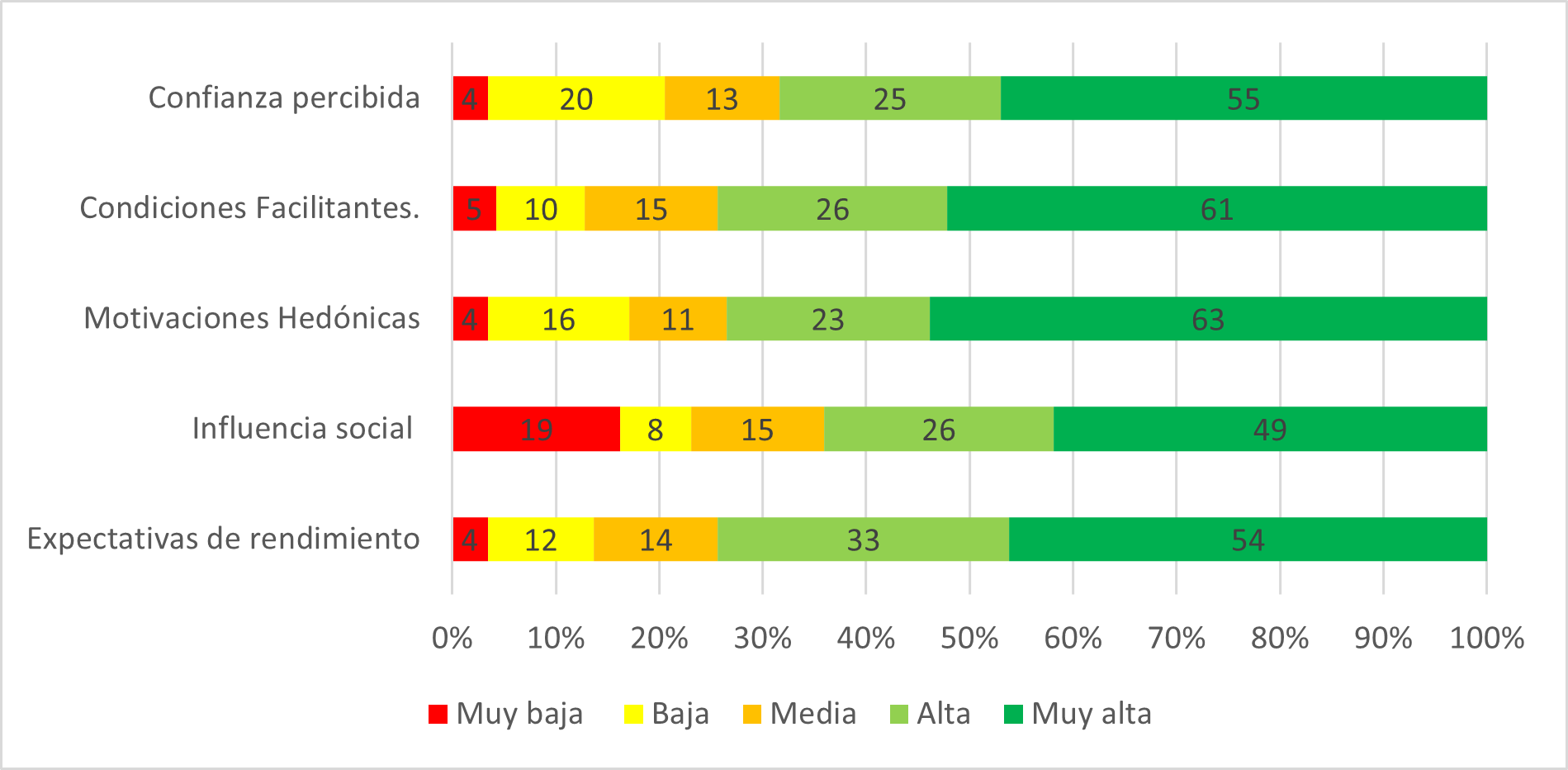
Today the issue of e-commerce has become relevant due to the growth it has had in recent years. This study analyzes the level of experience of e-commerce and consumer behavior through quantitative methods, in order to identify the effect on the variables age and gender, the methodology used is a quantitative approach, collecting information from different consumers through the application of a survey that allows to know the habits and their experiences when making online purchases regarding expectations of effort; hedonic motivations; perceived trust; performance expectation and social influence, identifying the variations that are taken into account taking into account age and gender, the sampling used is for convenience and voluntary for data collection, the reliability analysis quantified by Cronbach's alpha is 0.968. The results show that age influences purchasing experiences and habits, on the contrary, gender does not, resulting in the lowest levels being social influences and the highest being hedonic or pleasure motivations.
Article Details
References
Ábrego, D., Mendoza, J. y Salas, M. (2021). Relevance, attitude and the real use of e-commerce. Investigación Administrativa. Vol. 127. https://doi.org/10.35426/iav50n127.03
Agudo, Á. (2014). Análisis de los factores de adopción de comercio electrónico en segmentos de consumidores finales. Aplicación al caso español (Doctoral disertación, Industriales). E.T.S.I. Industriales (UPM) https://doi.org/10.20868/UPM.thesis.29489
Chaparro-Peláez, Julián & Agudo-Peregrina, Ángel F. & Pascual-Miguel, Félix J. (2016). "Conjoint analysis of drivers and inhibitors of e-commerce adoption," Journal of Business Research, Elsevier, vol. 69(4), pages 1277-1282. https://doi.org/10.1016/j.jbusres.2015.10.092
Baptista, M., Fátima, M. y Mora, C. (2010). Neuromarteking: Conocer al Cliente por sus Percepciones (Neuromarketing: know customers through their perceptions). TEC empresarial. Vol. 4 No. 3 pp. 9-19. https://revistas.tec.ac.cr/index.php/tec_empresarial/article/view/637
Bettman, J. (1973). Perceived risk and its components: A model and empirical test. Journal of Marketing Research. Vol. 10 pp. 84-90. https://doi.org/10.2307/3149824
Calce, S., Eastlick, M. A., Lotz, S. L. y Warrington, P. (2001). Un modelo de intenciones de pre-compra en línea: El papel de la intención de búsqueda: Premio al Mejor Artículo General - La Sexta Conferencia Trienal de Comercio Minorista AMS/ACRA, 2000. Revista de venta al por menor, Vol. 77 (3), 397-416. https://doi.org/10.1016/S0022-4359(01)00051-3
Eastlick, M., Lotz, S., Shim, S. y Warrington, P. (2001). An Online Prepurchase Intentions Model: The Role of Intention to Search. Journal of Retailing Vol. 77 No. 3 pp. 397-416 http://dx.doi.org/10.1016/S0022-4359(01)00051-3
Erdem, T., Valenzuela, A. y Zhao, Y. (2004). Performance of store brands: A cross-country analysis of consumer store brand preferences, perceptions, and risk. Journal of Marketing Research, Vol. 41 pp. 86-100. https://ur.booksc.me/book/37016656/2eb0b2
Erdem, T., y Swait, J. (1998). Brand equity as a signaling phenomenon. Journal of Consumer Psychology. Vol. 7 No. 2 pp. 131-157. https://www.sciencedirect.com/science/article/abs/pii/S1057740898703675
Fernández, A., Sánchez, M., Jiménez, H. y Hernández, R. (2015). La importancia de la Innovación en el Comercio Electrónico. Universia Business Review, Vol. 47 pp. 106-125. http://www.redalyc.org/articulo.oa?id=43341001006
González, J. (2016). Análisis regulatorio de las Telecomunicaciones y Comercio Electrónico Ecuatoriano para el Servicio de Cloud Computing. Investigación, Tecnología e Innovación. Vol. 8 pp. 131-138. http://www.jcelleri.com/project/analisis-regulatorio-de-las-telecomunicaciones-y-comercio-electronico-ecuatoriano-para-el-servicio-del-cloud-computing/
Gotlieb, J., Grewal, D. y Marmorstein, H. (1994). Moderating effects of message framing and source credibility on the price-perceived risk relationship. Journal of Consumer Research, Vol. 21 pp. 145-153. https://www.jstor.org/stable/2489746
Juárez, P. y Romo, A. (2017). Diagnóstico del comercio electrónico en las empresas mexicanas. Boletín Científico de las Ciencias Económico Administrativas del ICEA. Vol. 5 No. 10. https://doi.org/10.29057/icea.v5i10.2472
Karande, K. y Zinkhan, G. (1991). Cultural and gender differences in risk-taking behavior among American and Spanish decision-makers. Journal of Social Psychology, Vol. 131 No. 5 pp. 741-742. https://doi.org/10.1080/00224545.1991.9924657
Kim, H., Kim, M., Song, K., Park, Y., Kim, S., Joo, J., y Lee, J. Y. (2003). EMI shielding intrinsically conducting polymer/PET textile composites. Synthetic Metals. Vol. 135-136 pp. 105-106. https://koreauniv.pure.elsevier.com/en/publications/emi-shielding-intrinsically-conducting-polymerpet-textile-composi
Londoño, B. y Tavera, J. (2014). Factores determinantes de la aceptación tecnológica del e-commerce en países emergentes. ResearchGate https://www.researchgate.net/publication/272177387_Factores_determinantes_de_la_aceptacion_tecnologica_del_e-commerce_en_paises_emergentes
Loor, J., Navarro, A., De Lucca, J. y Gonzabay, D. (2018). E-commerce: un factor fundamental para el desarrollo empresarial en el Ecuador. Revista Científica ECOCIENCIA Vol. 5 pp. 1-17 https://doi.org/10.21855/ecociencia.50.156
Medina, J. M. (2018). Confidence and perceived control as antecedents of the acceptance of e-commerce: An empirical investigation in final consumers. Nova Scientia, Vol. 10 No. 21 pp. 655-677. https://doi.org/10.21640/ns.v10i21.1611
Mendoza, A. (2018). Factores asociados a la intención de uso del comercio electrónico en Bogotá. Sistema Nacional de Bibliotecas SISNAB http://hdl.handle.net/10823/1256
Mendoza, T. (2020). Procedimiento para la dinamización de la cultura organizacional en ETECSA (Bachelor's thesis, Universidad de Holguín, Facultad de Ciencias empresariales y Administración, Departamento de Ingeniería industrial). https://rus.ucf.edu.cu/index.php/rus/article/view/2750/2709
Pacheco, R. (2019). Habilidades Gerenciales y E-commerce en las Empresas Artesanales de la Ciudad de Huánuco, 2018. https://repositorio.uap.edu.pe/xmlui/bitstream/handle/20.500.12990/5868/Tesis_Habilidades%20Gerenciales-Huanuco.pdf?sequence=1&isAllowed=y
Reyes, J. y Valente, G. (2020). Análisis del impacto del covid-19 en el rendimiento de pequeños negocios del mercado gastronómico del sector de Urdesa-Guayaquil (Bachelor's thesis, Universidad de Guayaquil, Facultad de Ciencias Administrativas). http://repositorio.ug.edu.ec/handle/redug/54992
Sánchez-Vallejo, D., Carrión-Hurtado, L., & Granda-Sanmartín, M. (2022). Reacción del consumidor online en tiempos de COVID-19. CIENCIAMATRIA, 8(3), 73-82. https://doi.org/10.35381/cm.v8i3.742
Vega Barrios, A., Cerón Islas, A., & Figueroa Velázquez, J. G. (2021). Perspectivas de eCommerce y los Hábitos de Consumo Tras COVID-19. European Scientific Journal, ESJ, 17(4), 112. https://doi.org/10.19044/esj.2021.v17n4p112